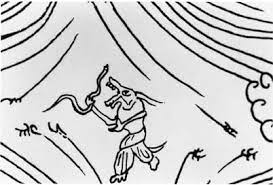
Classic of Mountains and Seas– The text in this brief chapter gave a look at the history of mountains in all core compass directions with the central mountains civilized gave a insight on the many oddities that lay beyond in distant mountains. The Classic’s purpose served for helping travelers document their findings to assist others in their own travels telling of the many geographical wonders that bear witness to vile creatures and blessed mythical creatures. Modern researchers would use the book as a piece of history of what the Chinese people documented of their distant lands in detail.
Doctors, Diviners, and Magicians– Fangshi was a crucial part in history for as far back as Records of the Three Kingdoms (233-297) and became part of dynastic histories in History of the Later Han. The Biography’s tell of tales ranging from Divinators telling the future down to the exact detail to a boy who learned acupuncture at a young age to become a professional at it and ultimately have his career stunted by nobles unable to follow the medical advice he has told them. The stories gave insight on how the many can see a story from a man who took a steady medical path in youth along with a fortune teller giving exact predictions many years ahead of their time as equally realistic.
Tomb Burial– Chinese tombs is comparable to that of Egyptian tombs having great respect for those who passed on. Chinese tombs were all given items in order to appease the spirit in the other world, to help it in the new world it now lives in and not to incur wrath among the family with bad luck or disasters. Beyond the talk of spirits, the coffin itself acts as a seal for the body and spirit metaphysically and physically.
The Han Cult of the Dead and Salvific Religion– Chapter 2 of this text gave the reader a slice of what events would happen after a persons death. It gives a strong root to tomb burials and expands to the idea that many started to believe in the fact that gods were in fact the spirits of those who have died, acting their will onto the world of the living. Archer Yi in example saved the world before in death and was worshipped as the original Astral Spirit.
On Death By: Wang Chong– Wang believed in every possible sense of the word that in death there was no such thing as a spirit that existed after passing. His many examples stemming from the indisputable fact of the “Vital Fluid”, most likely meaning blood, being exhausted once a person dies becoming afterwards part of the earth. Chong would circle back to this point in several instances whilst bringing up the point of the abundance of ghosts being greater than those alive on earth.
Personal Thought– The connection to the previous weeks research would be the fact of spirits considered part of Yin and those who are alive are part of Yang. There were many interesting parts of history from the biography’s that I enjoyed but i disliked reading through the Han Cult section for it being similarly structured to Classics of Mountains and Seas, aka the listing format. Overall it was a nice change of pace getting to know how intertwined the supernatural and the realistic histories of this era are.
